
Make Your Own Perfume Creating your own signature fragrance is one of the most rewarding ways to express your personality. Whether you enjoy floral, citrus, woody, or fresh scents, learning how to make your own perfume gives you complete control over every ingredient and fragrance note. Unlike many commercial perfumes, a homemade perfume allows you to customize the scent, avoid unnecessary additives, and experiment with unique fragrance combinations. Make Your Own Perfume
In this comprehensive guide, you’ll learn everything from perfume ingredients and fragrance families to blending techniques and expert tips. Whether you’re a beginner or simply curious about DIY perfume making, this guide will help you create a fragrance that truly reflects your style.
What Does “Make Your Own Perfume” Mean?
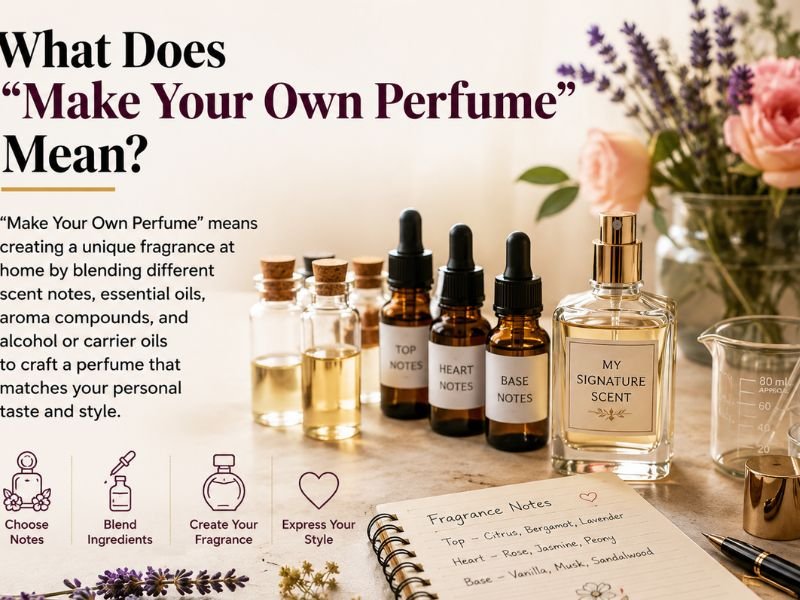
Making your own perfume means creating a personalized fragrance by blending aromatic ingredients in carefully balanced proportions. Instead of purchasing a ready-made fragrance, you choose each scent note yourself, allowing you to design a perfume that perfectly matches your preferences. Make Your Own Perfume
A homemade perfume usually consists of three main elements:
- Fragrance ingredients
- A carrier (such as alcohol or oil)
- Time for the fragrance to mature
Professional perfumers often spend months refining a fragrance, but beginners can create beautiful scents with a simple understanding of perfume structure and ingredient balance.
Why Make Your Own Perfume?
There are many reasons why DIY perfume making has become increasingly popular among fragrance lovers. Make Your Own Perfume
Personalization
Everyone’s scent preference is unique. When you make your own perfume, you can combine ingredients that perfectly suit your personality instead of settling for a fragrance designed for the mass market.
Whether you enjoy sweet vanilla, fresh citrus, elegant florals, or warm woody notes, your perfume becomes completely unique. Make Your Own Perfume
Cost Savings
Luxury perfumes often come with premium price tags. Creating your own fragrance at home can be significantly more affordable, especially if you plan to make multiple bottles using the same ingredients.
Many essential oils last for dozens of perfume batches, making them an economical investment.
Creative Expression
Perfume making combines science with creativity.
Experimenting with different fragrance combinations helps you understand how scents interact while giving you the freedom to create something completely original. Make Your Own Perfume
Many hobbyists eventually develop their own signature fragrance.
Natural Ingredients
Commercial fragrances sometimes contain synthetic ingredients that some people prefer to avoid.
By making your own perfume, you decide exactly what goes into the bottle, including natural essential oils and plant-based carrier oils. Make Your Own Perfume
Eco-Friendly Benefits
DIY perfume making can also reduce waste.
Reusable glass bottles, refillable atomizers, and carefully selected ingredients help minimize unnecessary packaging and plastic waste. Make Your Own Perfume
Many perfume enthusiasts also appreciate buying ingredients in bulk to reduce environmental impact.
Ingredients Needed to Make Your Own Perfume
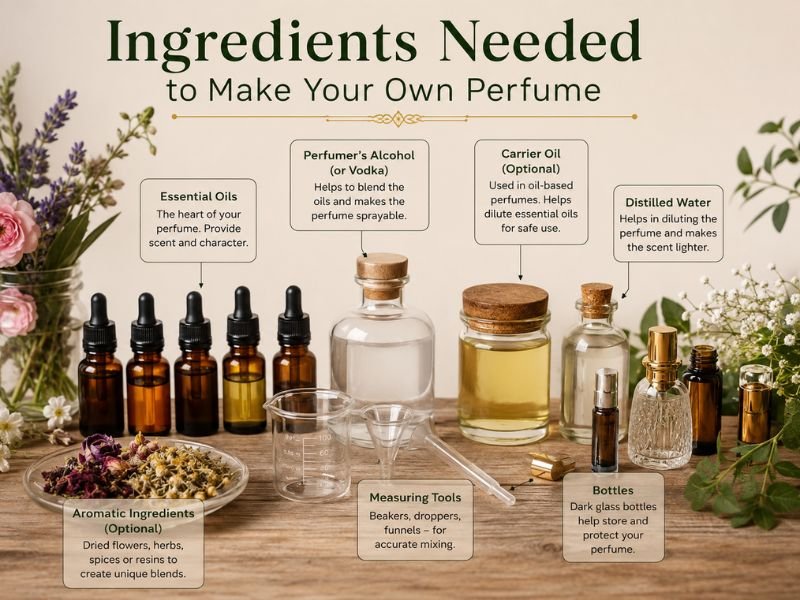
Before mixing your first fragrance, it’s important to understand the purpose of every ingredient.
Essential Oils
Essential oils provide natural fragrance extracted from flowers, leaves, wood, fruit peels, herbs, and roots.
Popular beginner choices include:
- Lavender
- Lemon
- Bergamot
- Cedarwood
- Sandalwood
- Rose
- Jasmine
Each essential oil contributes a different aroma and affects how long the perfume lasts.
Fragrance Oils
Fragrance oils are specially formulated aromatic oils designed to create scents that may not naturally exist as essential oils. Make Your Own Perfume
They often provide greater consistency and a wider variety of fragrance profiles.
Carrier Oils
If you’re creating an oil-based perfume, you’ll need a carrier oil.
Common options include:
- Jojoba Oil
- Fractionated Coconut Oil
- Sweet Almond Oil
Carrier oils dilute essential oils while making them safe for skin application.
Perfumer’s Alcohol
Alcohol-based perfumes use cosmetic-grade perfumer’s alcohol to disperse fragrance evenly and create the familiar fine mist associated with spray perfumes. Make Your Own Perfume
Perfumer’s alcohol also helps fragrance molecules blend together during the maturation process.
Distilled Water
A small amount of distilled water may be added after aging to slightly soften the fragrance and improve spray performance.
Only distilled water should be used to reduce the risk of contamination. Make Your Own Perfume
Fixatives
Fixatives slow down evaporation and help fragrances last longer.
Examples include:
- Benzoin
- Labdanum
- Ambroxan
- Orris Root
- Sandalwood
Some base notes naturally function as fixatives.
Measuring Tools
Accurate measurements are essential.
Useful tools include:
- Digital scale
- Measuring cylinders
- Pipettes
- Graduated droppers
Precision improves consistency between batches.
Glass Spray Bottles
Dark-colored glass bottles protect perfume from sunlight, helping preserve fragrance quality.
Amber and cobalt blue bottles are excellent choices.
Droppers
Droppers allow precise control over each essential oil.
Even one extra drop can noticeably change the final fragrance.
Funnels
A small funnel makes transferring perfume into bottles much easier while preventing spills.
Understanding the Perfume Note Pyramid
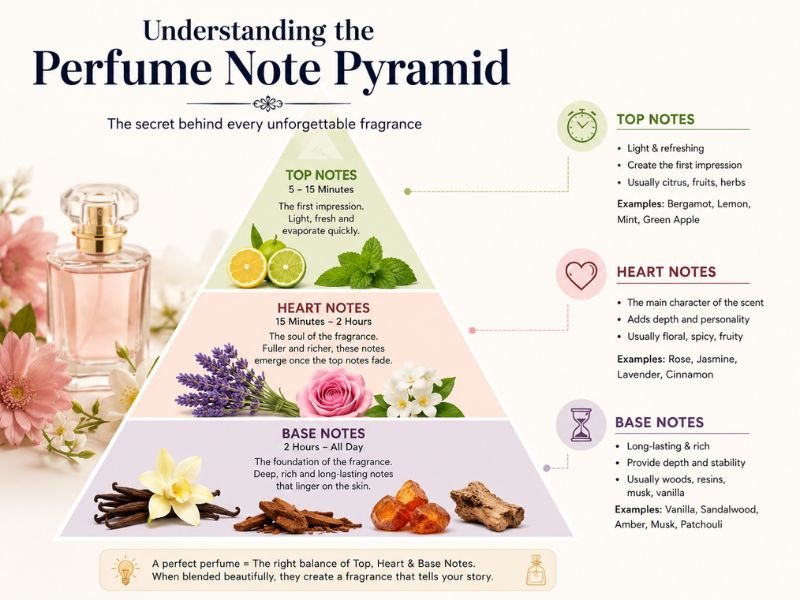
Every balanced perfume follows a fragrance structure known as the perfume pyramid.
Understanding this concept is one of the most important steps in learning how to make your own perfume. Make Your Own Perfume
Top Notes
Top notes create the first impression.
They are light, fresh, and evaporate quickly.
Examples include:
- Lemon
- Bergamot
- Grapefruit
- Orange
These scents typically last between 15 and 30 minutes.
Middle Notes
Middle notes appear once the top notes fade.
They form the heart of the fragrance and define its overall personality.
Popular choices include:
- Lavender
- Rose
- Jasmine
- Geranium
These notes usually remain noticeable for several hours.
Base Notes
Base notes provide depth, warmth, and longevity.
They linger on the skin long after the lighter notes disappear.
Examples include:
- Sandalwood
- Cedarwood
- Vanilla
- Patchouli
- Musk-inspired accords
These notes may remain detectable for six hours or more depending on the formula.
Step-by-Step Guide to Make Your Own Perfume
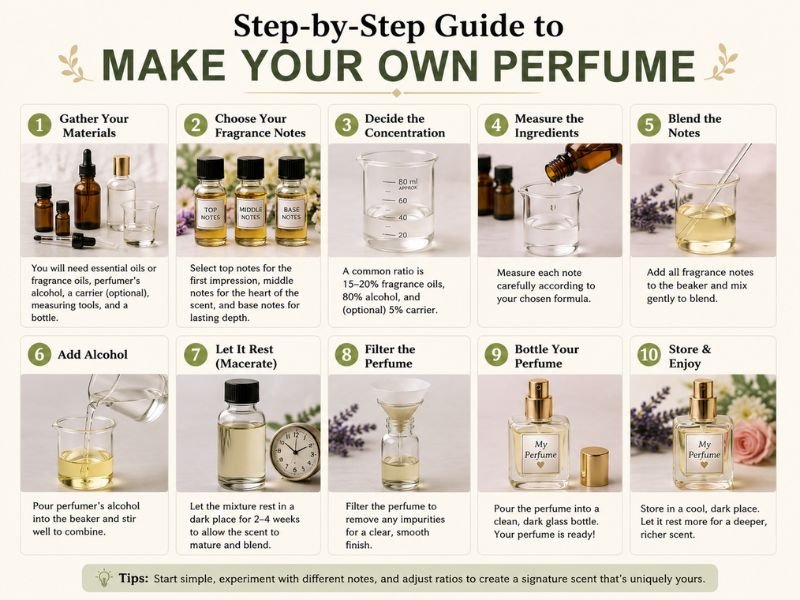
Step 1: Choose Your Fragrance Family
Before selecting individual ingredients, decide what overall scent you want. Make Your Own Perfume
Common fragrance families include:
Floral
Elegant and romantic.
Examples:
- Rose
- Jasmine
- Peony
- Lily
Perfect for everyday wear.
Citrus
Fresh and energetic.
Examples:
- Lemon
- Orange
- Bergamot
- Grapefruit
Ideal for warm weather.
Woody
Rich and sophisticated.
Examples:
- Cedarwood
- Sandalwood
- Vetiver
Popular in masculine and unisex fragrances.
Oriental (Amber)
Warm and luxurious.
Often combines:
- Vanilla
- Amber
- Spices
- Resinous notes
Excellent for evening wear.
Fresh
Light, clean, and airy.
Includes:
- Green notes
- Marine accords
- Herbal ingredients
Suitable for daily use.
Step 2: Select Your Top Notes
Choose one or two light ingredients that immediately capture attention.
Examples:
- Bergamot
- Lemon
- Mandarin
- Sweet Orange
These should represent approximately 20–30% of your fragrance blend.
Step 3: Select Your Middle Notes
Your heart notes define the perfume’s character.
Good beginner combinations include:
- Lavender + Rose
- Jasmine + Geranium
- Orange Blossom + Ylang-Ylang
These usually account for 40–50% of the blend.
Step 4: Select Your Base Notes
Choose ingredients that provide lasting power.
Examples include:
- Sandalwood
- Cedarwood
- Vanilla
- Patchouli
Base notes generally make up 20–30% of the fragrance composition.
Step 5: Blend Proper Ratios
Once you’ve selected your notes, combine them gradually using droppers.
A beginner-friendly starting ratio is:
- 30% Top Notes
- 50% Middle Notes
- 20% Base Notes
Blend slowly and smell the mixture after every few drops. Avoid rushing the process, as even small adjustments can significantly change the fragrance.
Advanced Perfume Blending Techniques
Once you understand the basics of perfume making, the next step is learning how to create a fragrance that smells balanced, lasts longer, and develops beautifully over time. Professional perfumers rarely mix ingredients randomly. Instead, they carefully build a fragrance layer by layer. Make Your Own Perfume
A good custom perfume should smell pleasant from the first spray until the final dry-down. This happens when the top, middle, and base notes complement each other instead of competing for attention.
Test Small Batches First
Before making a full bottle, prepare a small sample of 5–10 ml. This allows you to experiment without wasting expensive ingredients.
Write down every ingredient and the exact number of drops you use. Keeping detailed notes makes it much easier to recreate a successful fragrance later.
Give Your Perfume Time to Mature
Freshly blended perfume rarely smells exactly as it will after aging. The fragrance molecules need time to combine and settle.
For alcohol-based perfumes:
- Let the bottle rest for 2–6 weeks.
- Store it in a cool, dark place.
- Shake gently every few days.
Oil-based perfumes usually mature faster and may be ready within 1–2 weeks.
Beginner-Friendly Perfume Formulas
Different perfume types contain different fragrance concentrations. Higher concentrations generally provide better longevity but can also create a stronger scent. Make Your Own Perfume
| Perfume Type | Fragrance Concentration | Average Wear Time |
| Eau de Cologne | 2–5% | 2–3 hours |
| Eau de Toilette (EDT) | 5–15% | 3–5 hours |
| Eau de Parfum (EDP) | 15–20% | 6–8 hours |
| Perfume Extract | 20–30% | 8–12+ hours |
| Perfume Oil | 20–40% | 8–24 hours |
For beginners, an Eau de Parfum (EDP) offers an excellent balance between strength, longevity, and ease of formulation.
DIY Perfume Recipe Ideas
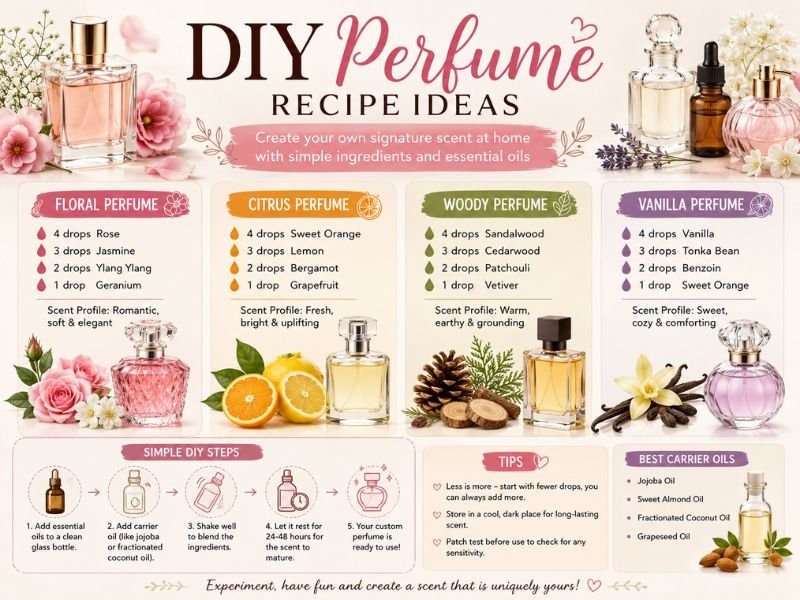
1. Fresh Citrus Blend
This perfume is ideal for warm weather and daytime wear. Make Your Own Perfume
Top Notes
- Bergamot
- Lemon
- Sweet Orange
Middle Notes
- Lavender
- Neroli
Base Notes
- Cedarwood
- White Musk-inspired accord
The result is bright, clean, and refreshing.
2. Romantic Floral Perfume
Perfect for everyday elegance.
Top Notes
- Bergamot
Middle Notes
- Rose
- Jasmine
- Peony
Base Notes
- Vanilla
- Sandalwood
This blend creates a soft floral fragrance with a warm finish.
3. Warm Woody Blend
Designed for cooler weather and evening wear.
Top Notes
- Black Pepper
- Bergamot
Middle Notes
- Lavender
- Cardamom
Base Notes
- Cedarwood
- Sandalwood
- Patchouli
Expect a rich, sophisticated scent with excellent longevity.
4. Sweet Vanilla Perfume
For those who enjoy gourmand fragrances.
Top Notes
- Mandarin
Middle Notes
- Jasmine
Base Notes
- Vanilla
- Tonka Bean-inspired accord
- Sandalwood
The fragrance opens with freshness before settling into a creamy, comforting base.
Common Mistakes to Avoid
Many beginners become discouraged because of simple errors that are easy to fix.
Adding Too Many Ingredients
Using a large number of essential oils often creates a confusing scent. Start with a small selection of complementary notes.
Ignoring Fragrance Balance
A perfume with too many top notes may smell pleasant at first but fade quickly. Too many base notes can make the fragrance feel heavy.
Skipping the Aging Process
Freshly mixed perfume often smells sharp or unbalanced. Allowing it to mature helps the fragrance become smoother and more harmonious.
Poor Storage
Heat, sunlight, and humidity can break down fragrance ingredients over time. Always store perfume in tightly sealed glass bottles away from direct light.
Safety Tips
Working with fragrance ingredients requires care.
- Always dilute essential oils before applying them to the skin.
- Perform a patch test on a small area of skin before regular use.
- Avoid contact with the eyes and sensitive areas.
- Keep perfume ingredients out of reach of children and pets.
- If you are pregnant, nursing, or have known allergies, consult a healthcare professional before using certain essential oils.
Expert Tips for Better Results
Professional perfumers often recommend these habits:
- Start with simple formulas before attempting complex blends.
- Buy high-quality fragrance materials from trusted suppliers.
- Label every bottle with the recipe and blending date.
- Test your perfume on skin as well as on paper strips, since body chemistry can change how a fragrance develops.
- Revisit your blend after a few weeks. Small adjustments can significantly improve the final result.
By practicing regularly and documenting your experiments, you’ll develop a better understanding of fragrance blending and create perfumes that reflect your personal style.
Homemade vs Store-Bought Perfume: Which One Is Better?
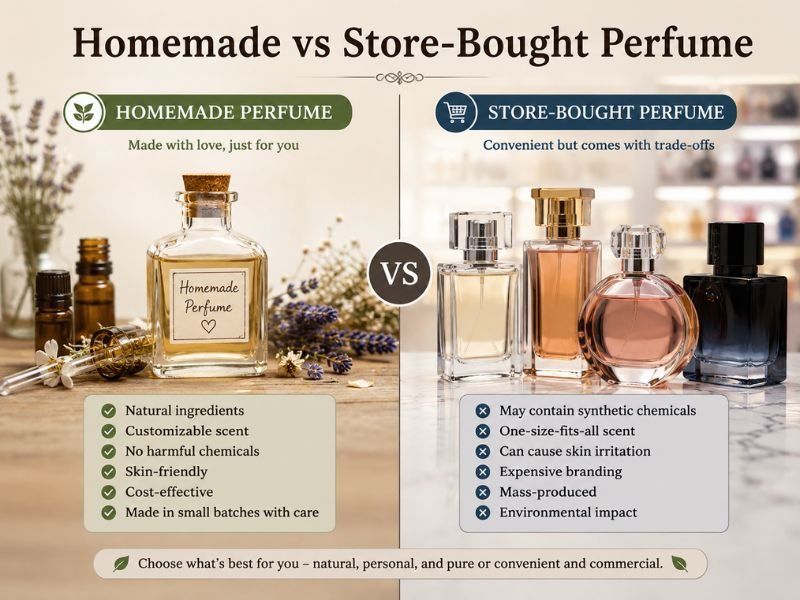
Choosing between a homemade perfume and a store-bought fragrance depends on your personal preferences, budget, and fragrance goals. Homemade perfumes offer complete creative freedom, while commercial perfumes provide consistency, professional formulation, and extensive testing.
If you enjoy experimenting with scents and want a fragrance that reflects your personality, making your own perfume can be a rewarding experience. On the other hand, if you prefer convenience and long-lasting performance without the blending process, a professionally crafted perfume may be the better choice.
Comparison Table
| Feature | Homemade Perfume | Store-Bought Perfume |
| Cost | Lower over time after purchasing ingredients | Higher, especially luxury brands |
| Customization | Fully customizable | Limited to available products |
| Ingredients | You choose every ingredient | Manufacturer decides the formula |
| Fragrance Variety | Unlimited combinations | Fixed fragrance profile |
| Longevity | Depends on the formula and ingredients | Usually optimized for longer wear |
| Environmental Impact | Refillable bottles can reduce waste | Often includes additional packaging |
| Learning Experience | Excellent for beginners and hobbyists | No learning required |
| Creativity | High | Low |
How Long Does Homemade Perfume Last?
The shelf life of homemade perfume varies depending on the ingredients, storage conditions, and whether the perfume is alcohol-based or oil-based.
As a general guide:
- Alcohol-based perfumes typically last 12–24 months when stored correctly.
- Oil-based perfumes usually remain fresh for 6–12 months.
- Citrus-heavy blends may fade sooner because citrus essential oils oxidize more quickly than woody or resinous oils.
To maximize longevity:
- Store perfume in a cool, dry place.
- Keep bottles away from direct sunlight.
- Use dark glass bottles whenever possible.
- Close the cap tightly after each use.
- Avoid exposing the perfume to heat and humidity.
If the fragrance changes color dramatically or develops an unpleasant odor, it is best to replace it.
Frequently Asked Questions (FAQs)
1. Can beginners make their own perfume?
Yes, beginners can easily make perfume using simple ingredients, basic tools, and easy fragrance recipes.
2. How long does homemade perfume last?
A well-made homemade perfume typically lasts between 6 and 24 months when stored properly.
3. What are the best essential oils for DIY perfume?
Lavender, bergamot, rose, jasmine, sandalwood, cedarwood, and vanilla are excellent choices for beginners.
4. Do homemade perfumes last as long as commercial perfumes?
Homemade perfumes can last for several hours, but longevity depends on the ingredients and fragrance concentration.
5. Can I make perfume without alcohol?
Yes, you can create an alcohol-free perfume by using carrier oils like jojoba or fractionated coconut oil.
Conclusion
Learning how to make your own perfume is a fun and rewarding way to create a fragrance that matches your personality and preferences. By choosing quality ingredients, understanding perfume notes, and following the right blending techniques, you can craft a unique scent that’s both enjoyable to wear and completely your own.