
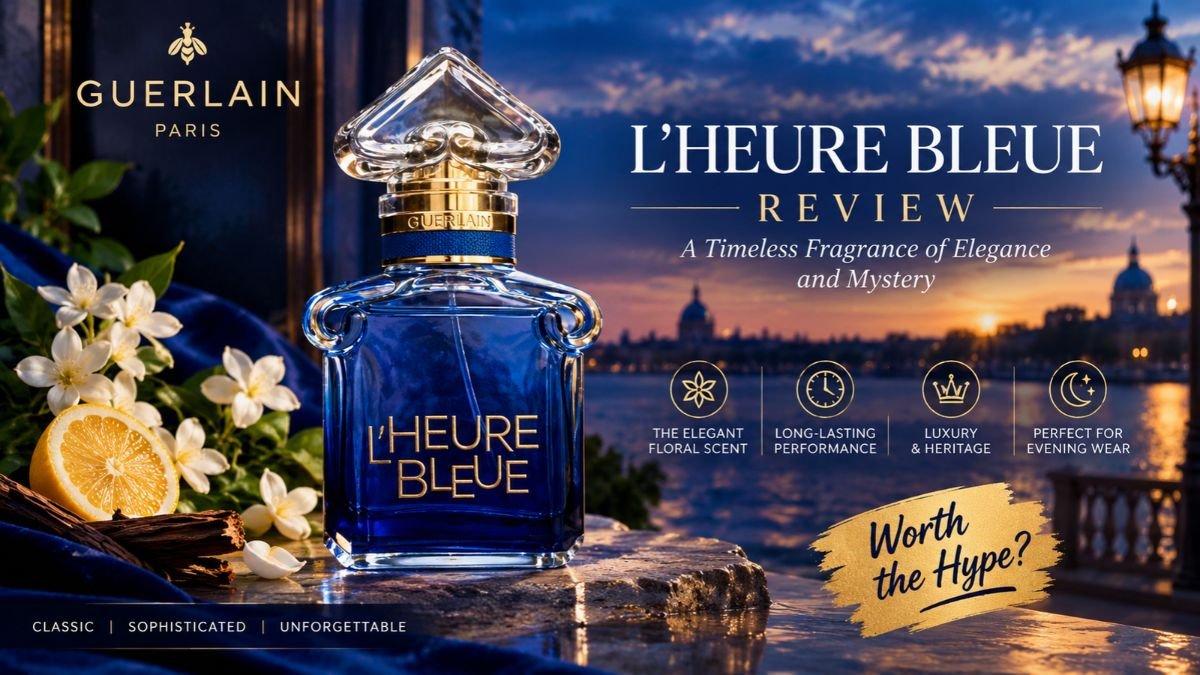
L’Heure Bleue by Guerlain is a fragrance name associated with one of perfumery’s most atmospheric ideas: the brief transition between daylight and night. First introduced in 1912, the original perfume was created by Jacques Guerlain and inspired by the blue hour, when the sky takes on a deep, subdued appearance after sunset. Rather than simply representing a collection of pleasant smells, its concept connects fragrance with a particular mood and moment in nature. More than a century later, the name continues to attract attention from people interested in classic perfumery, elegant floral compositions, and the history of luxury fragrance.
Understanding L’Heure Bleue requires a little care because the name now connects the historic composition with a contemporary interpretation. The original fragrance has a long-standing place in Guerlain’s heritage, while the newer Eau de Parfum introduces its own interpretation of the blue-hour concept. In this review, we explore the fragrance’s background, scent characteristics, composition, wearing occasions, performance considerations, and important details to understand before choosing a bottle. The aim is to help readers decide which interpretation deserves their attention without relying on exaggerated claims or assumptions about personal preference.
What Is L’Heure Bleue?
L’Heure Bleue is a perfume from the French fragrance house Guerlain. Its French name translates to “the blue hour,” a term describing the atmospheric period when daylight fades and the sky develops a deep blue appearance. The name provides the central idea behind the fragrance: capturing a fleeting moment through scent.
The original perfume was created by Jacques Guerlain in 1912. It became associated with a style of perfumery that values complexity, carefully balanced floral notes, warmth, and a recognizable overall character. Its historical importance comes not only from its age but also from the way it expresses a particular atmosphere rather than following a simple fresh, fruity, or sweet fragrance formula.
The name also appears in connection with a modern Eau de Parfum introduced in 2026. This interpretation was developed by Delphine Jelk, Guerlain’s Director of Perfume Creation, and presents the blue-hour theme through a different composition.
For readers researching L’Heure Bleue, the distinction matters. A review of the original fragrance should not automatically be treated as a description of the newer Eau de Parfum. Their shared name and inspiration connect them, but their specific notes and scent experiences are not identical.
The History and Inspiration Behind L’Heure Bleue
A fragrance inspired by twilight
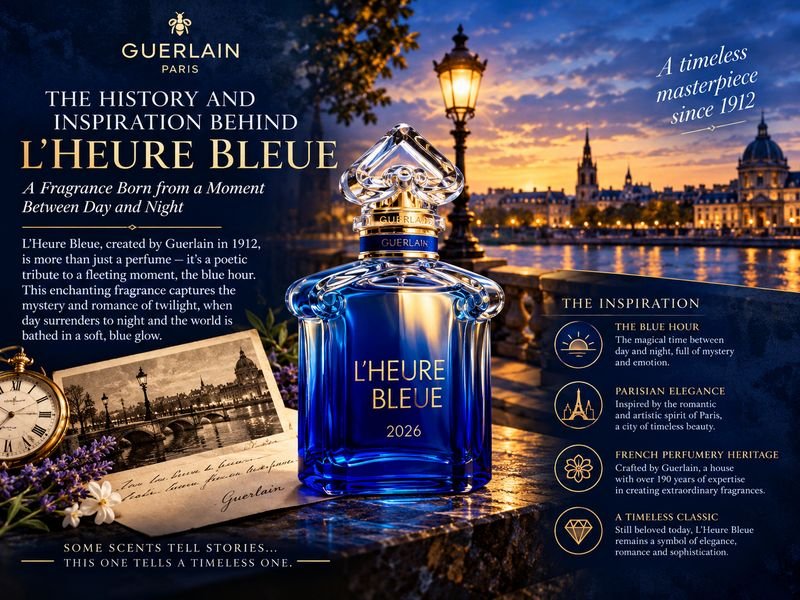
The story of the original L’Heure Bleue begins with Jacques Guerlain’s appreciation of the light in Paris. In 1912, the atmosphere around the Seine and the Pont-Neuf inspired him to capture the feeling of the blue hour in a perfume.
This idea gave the fragrance a distinctive creative direction. Instead of using a famous place or a particular flower as its sole inspiration, Guerlain sought to express a temporary natural experience. The result was intended to evoke the quiet beauty of the transition from day to night.
That concept remains relevant because fragrance is often connected with memories, places, seasons, and emotions. A particular scent can remind someone of a garden, a rainy afternoon, or a familiar room. L’Heure Bleue approaches fragrance from a similar perspective, using an atmospheric idea as the starting point for its composition.
Jacques Guerlain’s contribution
Jacques Guerlain was an important figure in the history of French perfumery. His work helped establish the house’s reputation for detailed compositions that combine several fragrance families into a unified scent.
The original L’Heure Bleue belongs to this historical tradition. Its identity is not defined by one simple note alone. Instead, its classic character is associated with floral, powdery, and warm elements that create a more layered impression.
For perfume enthusiasts, this makes the fragrance interesting beyond its immediate smell. It offers an example of how a perfume can express an artistic idea while demonstrating the compositional approach of its era.
A heritage that continues
The longevity of a fragrance’s reputation does not mean that every version remains unchanged. Perfumes can be reformulated, presented in different concentrations, or reinterpreted for new audiences. Packaging and availability can also change over time.
Guerlain’s newer L’Heure Bleue Eau de Parfum demonstrates how a historic name can inspire a contemporary creation. The newer interpretation preserves the blue-hour theme while using a different approach to iris, freshness, and vanilla.
The original fragrance, meanwhile, remains part of Guerlain’s Légendaires collection. This connection between heritage and reinterpretation makes it especially important to identify the specific version when reading reviews or comparing fragrance notes.
L’Heure Bleue Fragrance Notes and Scent Profile
Fragrance notes are the ingredients or scent impressions used to describe a perfume’s character. They are commonly grouped into opening, heart, and base notes, although the scent does not necessarily develop in perfectly separate stages.
Because L’Heure Bleue refers to both a historic perfume and a newer interpretation, its notes should be considered according to the version being discussed.
The original L’Heure Bleue
The original composition is associated with a classic floral and powdery character, with warmth that gives it depth. Iris, heliotrope, rose, and vanilla are among the materials commonly associated with descriptions of its traditional style. Its overall impression is often discussed in terms of softness, floral richness, and a gently sweet, comforting quality.
These descriptions are useful for understanding its fragrance family, but they should not be treated as a complete or guaranteed representation of every formulation. A perfume’s composition and perceived balance can differ between versions and across a long production history.
The classic scent is particularly relevant to readers who enjoy learning about vintage perfumery. Its appeal lies in the relationship between floral facets and warmer, powdery elements rather than in a single loud or immediately recognizable aroma.
The newer L’Heure Bleue Eau de Parfum
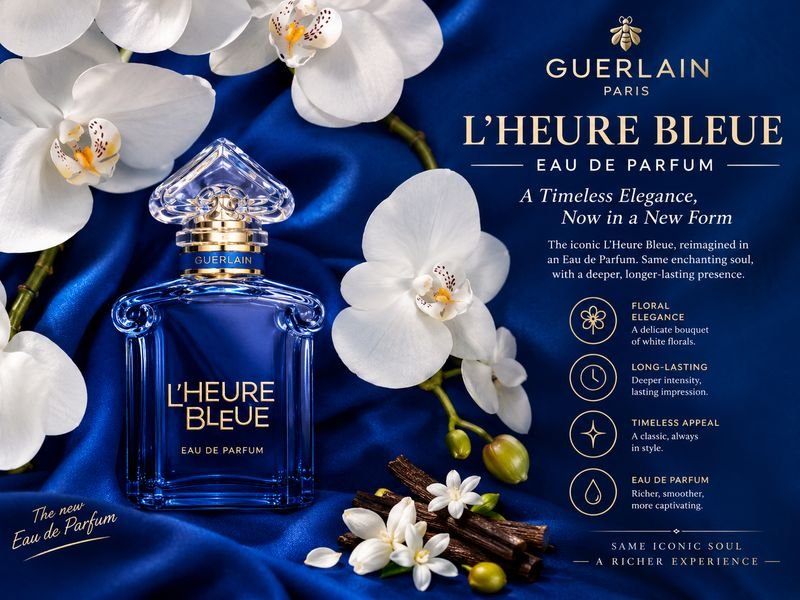
The newer interpretation offers a different scent profile. Guerlain describes it as an amber-floral fragrance built around an airy ozonic accord, iris, and vanilla.
Its published note structure includes pear and neroli in the opening, iris tincture, iris butter, and jasmine at the heart, and vanilla, ambroxan, and musks in the base.
The opening is intended to suggest freshness and airiness. Pear contributes a fruity impression, while neroli adds a floral-citrus character. These elements provide contrast to the softer, more textured iris that takes a central role in the composition.
Iris is especially important because its scent can be interpreted in different ways depending on the materials and the formula. In perfumery, iris-related ingredients may contribute powdery, earthy, woody, or softly floral impressions. They do not necessarily smell like a straightforward bouquet of fresh flowers.
Vanilla brings warmth to the newer fragrance. Rather than functioning only as a sugary dessert-like note, it can help connect the floral heart with the deeper base. Ambroxan and musks contribute to the overall foundation and help shape the fragrance’s lingering character.
Why the two versions should not be confused
The original and newer interpretations share a name, an inspiration, and a connection to Guerlain’s heritage. However, they should not be described as if they have identical formulas.
Someone searching for the classic perfume may be looking for its traditional powdery-floral identity and historical significance. Someone interested in the newer Eau de Parfum may instead want to explore its airy opening, specially developed iris tincture, and vanilla-inflected amber-floral structure.
Checking the product name, concentration, packaging, and description before buying can help prevent confusion.
How Does L’Heure Bleue Develop Over Time?
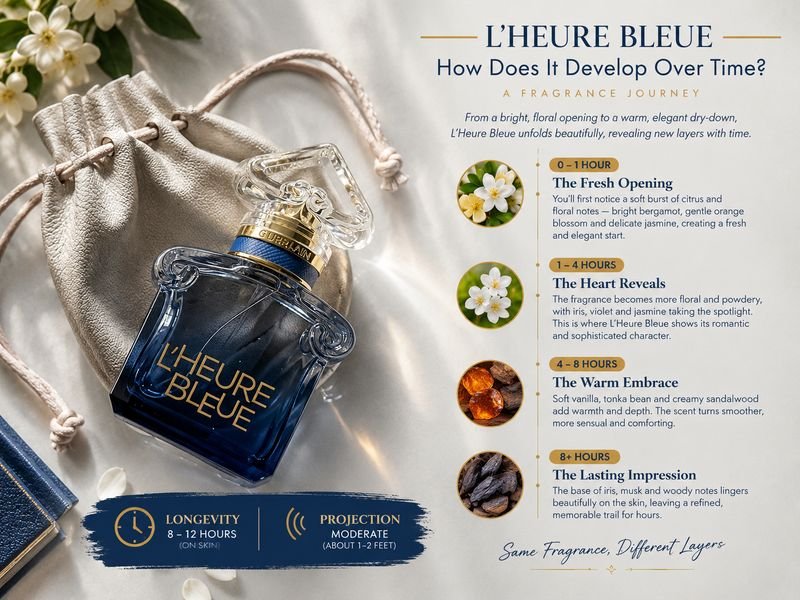
A perfume’s opening is only one part of its overall character. After application, its more volatile materials may become less noticeable while other parts of the composition remain prominent. This gradual change is often called fragrance development or the dry-down.
With the classic L’Heure Bleue, descriptions frequently emphasize the relationship between its floral, powdery, and warm facets. Rather than being understood only through its first impression, the perfume is often appreciated as a composition whose different elements contribute to an overall mood.
The newer Eau de Parfum uses a different structure. Its airy opening, iris-focused heart, and warm vanilla base are designed to create contrast between freshness and depth. As the fragrance settles, the warmer elements may become more noticeable relative to the initial freshness, although the experience will vary from person to person.
It is important not to assume that everyone will experience the same sequence. Skin, temperature, humidity, application amount, and individual sensitivity can all influence how a fragrance is perceived. A scent that seems soft and powdery to one wearer may appear sweeter, woodier, or more floral to another.
For this reason, sampling a fragrance on skin can be more informative than judging it from a note list alone.
What Makes L’Heure Bleue Distinctive?
A strong sense of atmosphere
The blue-hour concept gives the fragrance a clear identity. Its inspiration is not simply a fashionable ingredient or a particular season. It is a moment when the surroundings appear to change as daylight disappears.
This creative direction helps explain why L’Heure Bleue is often discussed as a fragrance with an evocative character. Its appeal can extend beyond whether someone likes a particular note. The composition also invites an association with quietness, softness, and the transition from light to darkness.
Floral notes with depth
Floral fragrances cover a wide range of styles. Some are bright and fresh, while others are creamy, green, powdery, spicy, or rich. L’Heure Bleue is interesting because its traditional identity is associated with floral materials presented alongside softer, warmer facets.
The newer interpretation explores a related idea through iris and vanilla, balanced with an airy accord. This combination allows the perfume to connect a sense of freshness with a more enveloping base.
Neither approach needs to be considered universally better. The original may appeal to someone interested in historical compositions, while the newer version may interest someone seeking a contemporary take on the same broad inspiration.
A recognizable heritage
Guerlain’s history is part of the fragrance’s appeal, particularly for people who enjoy exploring perfumes with a long-standing place in a brand’s collection. However, heritage alone does not determine whether a perfume will suit an individual.
A historic fragrance can be beautifully made and still feel unfamiliar to someone who prefers modern fresh scents. Equally, a contemporary interpretation may appeal to someone who wants a connection to perfume history without necessarily choosing the original composition.
The best way to judge L’Heure Bleue is to consider both its background and the actual scent profile of the version being sampled.
Who Might Enjoy L’Heure Bleue?
L’Heure Bleue may appeal to people who appreciate floral fragrances with a soft, powdery, or warm character. Its historic identity can be particularly interesting to readers who want to explore classic French perfumery rather than choosing a perfume based only on current trends.
The original may suit fragrance enthusiasts who enjoy compositions that feel layered and traditional. People who like iris, heliotrope, rose, and warm vanilla-style facets may find its general fragrance direction worth exploring, although personal testing is still important.
The newer Eau de Parfum may appeal to those who enjoy iris-centered fragrances with a more airy opening and a warm amber-floral base. Its contrast between freshness and vanilla creates a different entry point into the L’Heure Bleue name.
The fragrance is not limited to one age group or one type of wearer. Although classic perfume descriptions sometimes associate particular scents with gender, individual taste is more useful than rigid labels. Anyone can explore a fragrance if its character appeals to them.
On the other hand, people who strongly prefer very light citrus colognes, sharply green scents, or uncomplicated aquatic fragrances may find the warmer and more layered styles less aligned with their preferences. That does not make either version unsuitable; it simply highlights the importance of sampling before making a decision.
Best Seasons and Occasions to Wear L’Heure Bleue
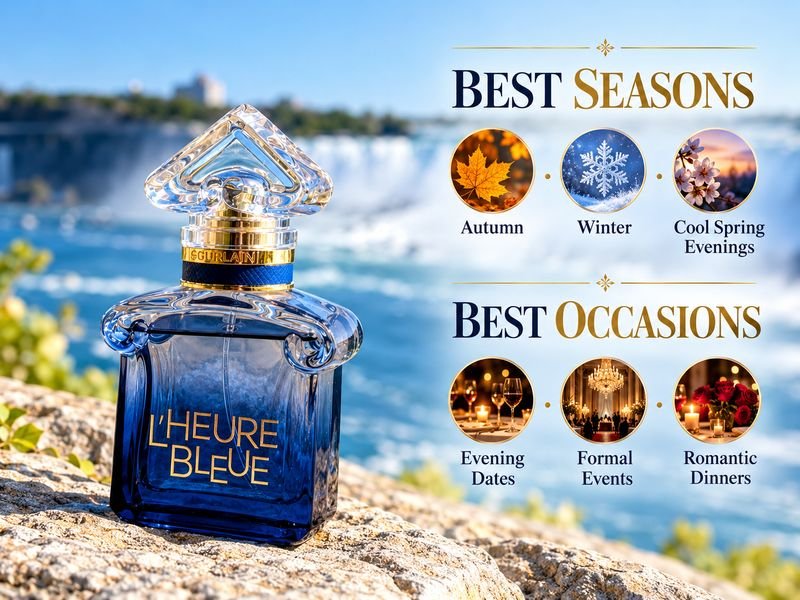
Autumn and winter
Warm, powdery, and floral compositions are often enjoyable in cooler weather because their character can feel especially comfortable and enveloping. The classic style of L’Heure Bleue may be worth sampling during autumn and winter if you appreciate fragrances with depth.
The newer interpretation also combines freshness with vanilla warmth, creating a contrast that may appeal in cooler conditions. However, there is no rule that either version must be restricted to cold weather.
Spring and summer
The suitability of a fragrance in warm weather depends on its formula, application, and the wearer’s comfort. A fragrance that feels pleasant in a cool room may become more noticeable outdoors in heat and humidity.
If you want to wear L’Heure Bleue during spring or summer, start with a modest application and assess how it develops. The newer interpretation’s airy opening may interest some wearers, but that does not automatically make it a light summer perfume.
Everyday use and special occasions
L’Heure Bleue can be considered for personal wear, dinners, cultural events, or other occasions where its character feels appropriate to the wearer. Whether it works as an everyday signature depends on how strongly you enjoy its scent and how noticeable you want your perfume to be.
A fragrance does not need to be reserved for formal occasions simply because it has a heritage or luxury positioning. If you enjoy the scent and it suits your surroundings, you may choose to wear it regularly.
For shared offices, classrooms, public transport, or close indoor settings, applying less fragrance is a considerate approach. The goal is to enjoy the perfume without overwhelming the people around you.
L’Heure Bleue Longevity and Projection: What to Know
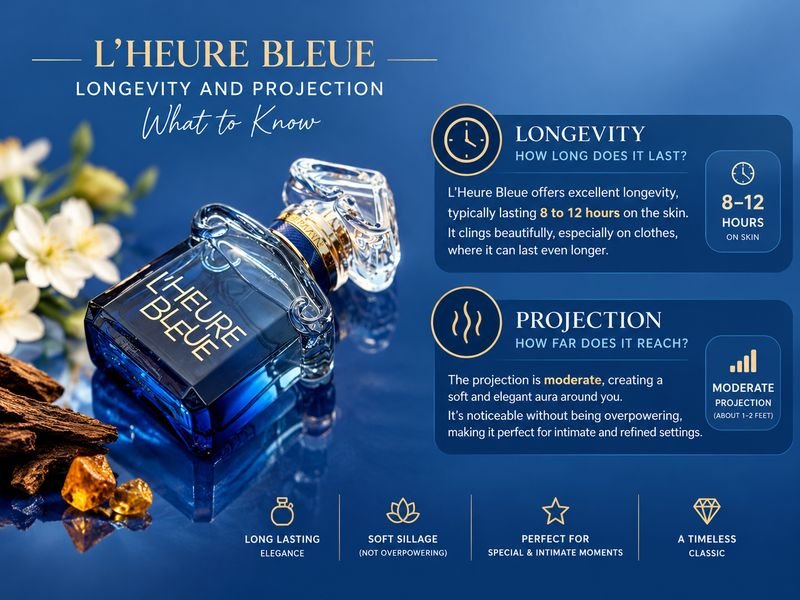
Longevity describes how long a fragrance remains detectable, while projection refers to how far its scent travels from the wearer. These terms are related, but they do not mean the same thing. A perfume may remain noticeable on skin without creating a large scent trail.
There is no single reliable longevity figure that applies to every L’Heure Bleue bottle, formulation, and wearer. Concentration, storage conditions, skin characteristics, application, temperature, and the surrounding environment can all affect performance.
The classic fragrance and the newer Eau de Parfum should also be evaluated separately. They have different compositions, so an experience with one version does not establish how the other will perform.
It is worth remembering that your own nose may gradually become less sensitive to a scent you have been wearing. This is sometimes called olfactory adaptation. If you stop noticing your perfume, it does not necessarily mean that other people can no longer detect it.
For a realistic assessment, test a small amount and observe how it changes over several hours. Avoid applying more simply because you can no longer smell it continuously. A measured approach makes it easier to understand the perfume’s actual presence and helps prevent excessive application.
Is L’Heure Bleue Worth Considering?
Whether L’Heure Bleue is worth considering depends on what you want from a fragrance. Someone searching for a classic perfume with a notable place in French fragrance history may be drawn to the original. Someone interested in a contemporary iris and vanilla composition may prefer to investigate the newer Eau de Parfum.
The original’s historic importance is a meaningful part of its appeal, but history alone should not be the deciding factor. A perfume is a personal purchase, and a celebrated fragrance may not suit every taste.
The newer interpretation offers its own reasons for consideration, including its iris-focused structure and contrast between airy freshness and warmth. However, it should be judged on its own merits rather than assumed to be a direct replacement for the historic composition.
Before buying, consider the exact version, concentration, intended use, and your preferred fragrance family. If possible, sample the perfume on skin and give it time to develop. This is especially useful for layered fragrances, where the opening may not fully represent the scent you experience later.
Price and availability may vary by market and retailer. Confirm the exact product details before making a purchase, and be cautious of listings that do not clearly identify the version being offered.
Important Things to Consider Before Buying
First, check the full product name. A listing for the original L’Heure Bleue should not be treated as interchangeable with a listing for the newer Eau de Parfum. Look at the packaging, product description, concentration, and other identifying details.
Second, consider your preferred scent style. If you enjoy powdery florals and traditional compositions, the classic version may be a useful starting point. If you prefer an airy opening supported by iris and vanilla, the newer interpretation may be more relevant to your interests.
Third, sample the perfume if you can. Fragrance descriptions help set expectations, but they cannot reproduce the complete experience of smelling a scent on your own skin. A sample also allows you to assess comfort, development, and performance without committing immediately to a full bottle.
Fourth, think about where you intend to wear it. A fragrance that feels appropriate for an evening out may need a lighter application in a shared indoor environment. Personal preference and consideration for others can comfortably coexist.
Finally, avoid treating popularity, price, or heritage as proof that a perfume is right for you. A fragrance can be historically important and still not match your taste. The most satisfying choice is one whose scent you genuinely enjoy and can comfortably wear.
How L’Heure Bleue Fits Modern Fragrance Preferences
Modern fragrance shoppers can choose from fresh aquatics, sweet gourmands, woody compositions, clean musks, bold ambers, and many other styles. In this broad market, a name such as L’Heure Bleue offers a connection to a more atmospheric approach to perfumery.
The classic version can introduce wearers to the layered floral and powdery styles associated with traditional French perfume. For someone accustomed mainly to fresh, simple compositions, this may be an opportunity to explore a different fragrance structure.
The newer interpretation provides another route. Its airy accord creates a fresher opening, while iris and vanilla connect that freshness with a warmer base. This makes it relevant to people who want to explore the L’Heure Bleue concept through a contemporary composition.
Neither style needs to compete with every modern trend. Fragrance preferences are varied, and many people enjoy moving between different families depending on their mood, setting, or the time of year.
The important point is to understand what you are sampling. Reading about the original’s history can explain its reputation, while examining the newer version’s published notes can help you decide whether its composition sounds appealing. Neither form of information can fully replace a personal test, but together they provide a more informed starting point.
Frequently Asked Questions About L’Heure Bleue
1. What is L’Heure Bleue by Guerlain?
L’Heure Bleue is a Guerlain fragrance name first associated with the original perfume created by Jacques Guerlain in 1912 and later used for a contemporary interpretation.
2. What does L’Heure Bleue smell like?
The classic fragrance is associated with floral, powdery, and warm facets, while the newer Eau de Parfum combines an airy accord, iris, and vanilla.
3. Who created the original L’Heure Bleue?
Jacques Guerlain created the original L’Heure Bleue in 1912, drawing inspiration from the blue hour in Paris.
4. Is L’Heure Bleue suitable for everyday wear?
It can be worn daily if its scent suits your preferences and surroundings, with a lighter application often best for shared indoor spaces.
5. Should I choose the original or the newer L’Heure Bleue Eau de Parfum?
Choose based on your preferred scent style, and sample each version separately because their compositions and fragrance experiences differ.
Conclusion
L’Heure Bleue remains an interesting name in perfumery because it connects a distinctive natural inspiration with more than a century of fragrance history. The original 1912 creation by Jacques Guerlain is associated with a classic floral, powdery, and warm style, while the newer Eau de Parfum explores the same blue-hour idea through an airy accord, iris, and vanilla. Neither version will appeal to every fragrance lover, and their shared name should not obscure their differences. By identifying the exact perfume, understanding its scent profile, and sampling it before buying, readers can make a more confident decision about whether L’Heure Bleue deserves a place in their fragrance collection.